Picture the category manager who has been sitting on the same question for three weeks: why did our southwest region soften while the rest of the country held? It is not a hard question. The data exists. What is missing is analyst bandwidth, and by the time the answer arrives, the promotional window it would have informed has already closed.
That gap between having the data and getting the answer is the quiet tax on every retail and CPG organization. And it is expensive. A 2025 retail and CPG data landscape survey found that only 8% of companies have scaled AI-powered analytics across multiple departments, while more than half named faster decision-making as their top priority for the year. Everyone wants speed. Almost nobody has it at scale.
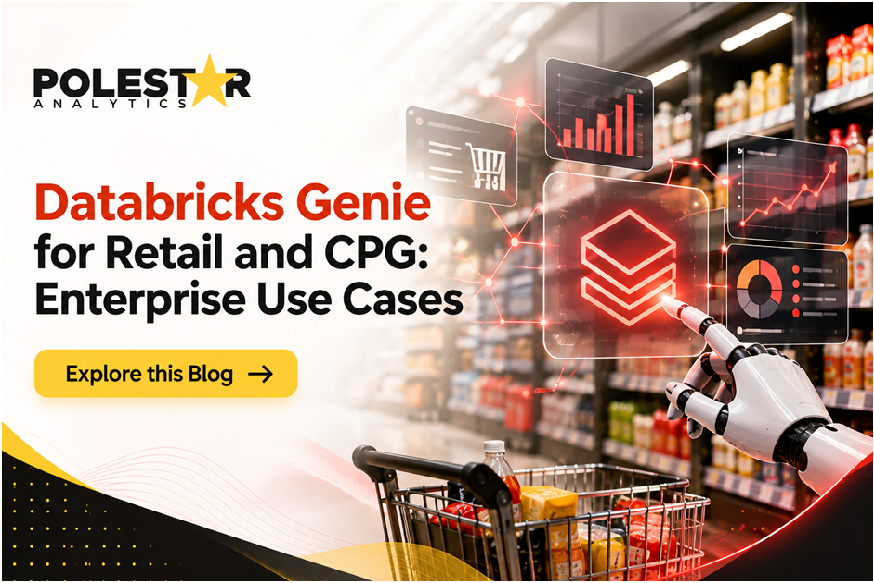
Databricks Genie is built to close that gap by letting business users ask questions of governed data in plain English. This piece walks through what it actually does, where it earns its place in retail and CPG specifically, and the honest tradeoffs of putting it into production.
Why Retail and CPG Analytics Struggle to Scale |
The bottleneck in this industry is rarely a shortage of data. It is the opposite problem, too much of it, arriving in incompatible shapes.
Most CPG brands sell through dozens of retail partners, and every retailer formats its data differently, which means ingestion and normalization, not analysis, is the real time sink. Analysts routinely lose the first two days of every week just normalizing retailer data into something comparable before any real thinking begins. The rest gets swallowed by a queue of routine requests from business users who cannot self-serve.
The outcome shows an unusual form of waste. Information is buried in the brain of some specialists, while separate teams repeat the work that has been completed six weeks back because nobody was aware of it. On a different note, if one team spends weeks on studying product movement in stores without realizing that the sales department did the same research a month ago, the issue is not the lack of analytical resources. It is access. That is the specific thing Genie is designed to change.
What Is Databricks Genie for Retail and CPG
Genie represents the conversational analytics layer integrated into the Databricks system. For Databricks Genie for Retail and CPG, users can simply type a question in natural language, and Genie transforms it into SQL to work with governed tables. It processes the request and provides results in the form of a chart, along with a short note explaining how the results were obtained. No SQL, no waiting on a ticket.
The detail that separates it from pointing a generic chatbot at your warehouse is grounding. A data team curates a Genie space by picking the right tables, writing the business definitions that matter, and adding example queries the team already trusts. Genie reviews this information to understand the context of the request and formulate the appropriate query. It is also important that each request is made in accordance with Unity Catalog privileges, ensuring a user sees only the information they are entitled to access and that the data is traceable. In retail, where a single question can involve loyalty information, pricing, and store sales at once, this governance allows self-service analytics to be used securely.
What Databricks Genie Changes on the Ground for Retail and CPG
Databricks Genie changes the workflow for retail and CPG. Business teams no longer have to depend on analysts or necessarily sift through numerous reports; they can now ask straightforward questions in their language and receive accurate answers based on data governance regulations. This means that the shift is not merely about quicker reporting; it is about empowering business users to self-explore data. There will be less demand for the analysts, meaning that they will spend more time unearthing information rather than addressing repetitive queries, and the business teams will have more time to take advantage of valuable information.
1. Merchandising and category management
Category and merchandising teams constantly need answers to questions like: Which promotions are driving incremental sales? Why is one region underperforming? Traditionally, finding those answers means waiting for analysts to pull reports from multiple systems. Genie lets business users ask those questions directly in plain English, compare products, regions, and promotions in seconds, and make faster merchandising decisions while the opportunity is still available.
When 7-Eleven introduced this facility, it was a cultural change as much as a technical one. According to one of their data leaders, the business users had been reaching out to analysts constantly for comparison of sales in various regions, and the ability to ask Genie instead of searching for the right person totally changed the way the team operated.
2. Speed to decision.
The retail sector is a rapidly changing one, and it can take too long for one’s decisions to be effective. Whether it is about redistributing stock, reacting to fluctuating demand, or changing a promotion, analysts can waste precious time gathering the needed data. Genie helps to minimize the time needed for decision-making.
The clearest proof is on the clock. Brazilian retail giant Grupo Casas Bahia embedded Genie in Microsoft Teams and cut analysis time on complex logistics and sales questions from five or six hours down to about two minutes, with executives querying in their native Portuguese. That is not a marginal gain. It is the difference between acting inside a promotional window and reading about it afterward.
3. Freeing the data team.
The majority of analytics teams do not devote their time to creating advanced models; rather, they spend it answering the same questions over and over again. Genie takes care of repetitive inquiries by empowering business people to perform their own common analyses, freeing up analysts to concentrate on strategic tasks like forecasting, optimising, and improving data quality rather than making routine reports. Genie does not replace analysts. It removes the routine requests that bury them.
Premier, which supports two-thirds of U.S. hospitals, launched Genie in three days and saw analysis run roughly ten times faster, freeing its analysts to refine models and metrics instead of answering the same lookup for the fifth time. The same pattern shows up on the floor, too. Furniture retailer Rooms to Go connected Genie to Microsoft Teams so warehouse and sales staff could explore data conversationally without leaving the tools they already use.
What Retail and CPG Teams Need Before Deploying Databricks Genie
Genie space is only as good as the data and definitions behind it. Pointing AI at a messy warehouse produces confident, wrong answers, which are worse than no answer at all. The teams that get it right treat setup as real work. They solve the questions business users actually ask, define the “ground truth” answer for each so accuracy can be verified, and build a feedback loop where expert users flag good and bad responses over time.
This is where an experienced Databricks partner earns its place. Polestar Analytics, a certified Databricks partner, does exactly this groundwork for retail and CPG clients, unifying fragmented retailer and channel data into a governed Lakehouse and curating the Genie spaces that sit on top of it. Having built the semantic layer and business definitions these teams rely on, Polestar Analytics helps ensure the answers Genie returns are ones the business can actually trust, which is the difference between a tool people pilot and one they depend on.
Cost discipline matters too. Genie now runs on pay-as-you-go pricing measured in Databricks Units, with a free monthly LLM allowance and admin-set budgets to keep spend visible. Worth setting those guardrails on day one rather than after the first surprising invoice.
Why Databricks Genie Matters for Retail and CPG
Retail and CPG teams are not short on data or ambition. What separates the leaders is speed to the answer, and that speed is gated by whether business users can reach governed data without standing in an analyst’s queue. Genie is not magic, and it will not rescue a broken data foundation or unclear business definitions on its own. What it does, when the foundation is solid, is collapse the distance between a question and a trustworthy answer from weeks to minutes. In an industry where the promotional window closes fast, that distance is the whole game.
Frequently Asked Questions About Databricks Genie for Retail and CPG
Q: Do business users need to know SQL to use Genie?
No. They ask questions in plain English, and Genie translates them into SQL against governed tables, returning a chart and a short explanation of how it got there. No queries to write, no waiting on an analyst’s ticket.
Q: Does Genie replace the data team?
No, it removes the routine requests that bury them. Business users self-serve the common questions, which frees analysts to focus on forecasting, optimization, and data quality rather than pulling the same report for the fifth time.
Q: What has to be in place before Genie works reliably?
A curated Genie space with the right tables, trusted business definitions, and example queries, all governed through Unity Catalog. Point it at a messy warehouse and it produces confident, wrong answers, so the setup is the real work.