
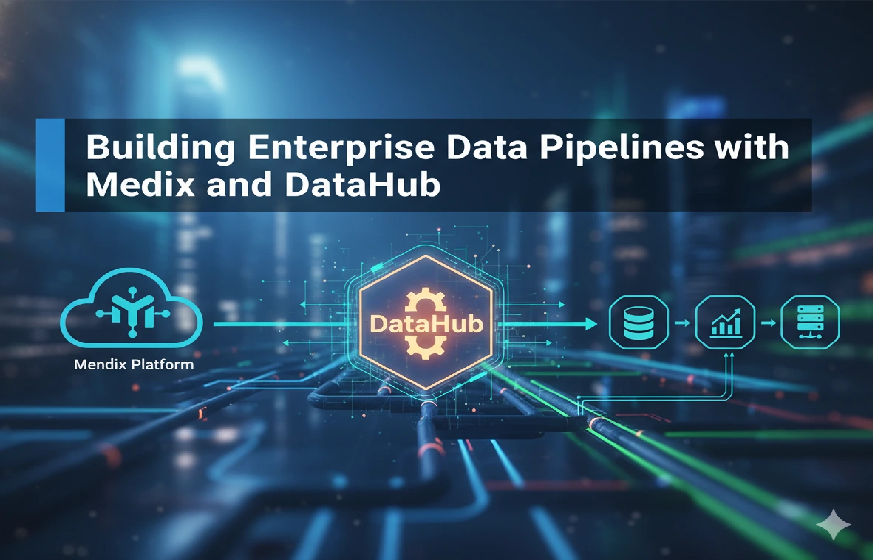
Enterprise organizations today operate in an environment where data is produced at unprecedented speed, scale, and complexity. As systems multiply—ERP, CRM, IoT devices, legacy databases, SaaS applications—the challenge is no longer whether data exists, but how to connect, govern, and utilize it efficiently across the enterprise.
This is where Mendix DataHub emerges as a cornerstone for federated data management, providing a modern, low-code approach to building enterprise data pipelines that integrate, expose, and synchronize data across distributed systems—securely and in real time.
At We LowCode, we have seen firsthand how organizations achieve transformative outcomes by leveraging DataHub in combination with robust Mendix architecture. Whether you collaborate with a seasoned Mendix Consultant or rely on full-scale Mendix Development Services, understanding how DataHub supports federated data pipelines is critical to maximizing your digitalization journey.
This advanced guide will walk you through the principles, patterns, and best practices for building enterprise-ready data pipelines using Mendix and DataHub.
1. Understanding Federated Data Management in the Mendix Ecosystem
1.1 What Is Federated Data Management?
Federated data management is an architecture where data remains in its original source systems but is made discoverable, governed, and consumable across the organization. Instead of copying data into a single repository, federated models enable applications to reference and interact with live data through standardized interfaces.
This approach solves several challenges:
- Eliminates redundant data copies
- Ensures real-time access to accurate information
- Reduces integration complexity and maintenance overhead
- Improves governance and compliance through controlled exposure
Mendix DataHub is designed precisely for this federated paradigm.
2. What Makes Mendix DataHub Critical for Enterprise Pipelines?
Mendix DataHub acts as a universal connector, allowing applications to consume and publish data services without traditional ETL pipelines or complex middleware.
2.1 Key Capabilities of DataHub
| Feature | Description |
| Data Catalog | A centralized repository where all published data sources are registered and governed. |
| Discoverability | Developers can browse certified and non-certified data sets directly within Mendix Studio Pro. |
| Data Integration via OData | Supports open OData protocol for consistent, standards-based interactions. |
| Governance & Access Control | Enforces permissions, ownership, versioning, and publishing guidelines. |
| Federated Data Consumption | Allows apps to reference data without duplicating or syncing manually. |
With these capabilities, Mendix DataHub fundamentally changes how enterprises build digital ecosystems by enabling frictionless, governed connectivity.
3. Architecture of an Enterprise Data Pipeline with Mendix & DataHub
A modern data pipeline using Mendix typically includes the following layers:
3.1 Source Systems
These can be:
- SAP, Salesforce, Oracle DB, Microsoft SQL Server
- IoT sensors and device telemetry
- Legacy on-prem systems
- SaaS applications
- Internal Mendix applications
DataHub connectors expose selected datasets from these systems as reusable services.
3.2 DataHub Catalog as the Central Governance Layer
Once registered, datasets become part of the enterprise’s certified data landscape. DataHub enforces:
- Data lineage
- Versioning policies
- Service-level ownership
- Permissions and user roles
- Endpoint accessibility rules
This ensures consistency and trust across applications.
3.3 Mendix Applications as Consumers and Producers
A Mendix app can act as:
- A producer: publishing APIs or data services into the DataHub.
- A consumer: referencing and using external data via DataHub.
This duality enables multi-directional data flows without traditional integration overhead.
3.4 Analytics, Visualization & AI Layer
Many enterprises extend pipelines into:
- BI tools (Power BI, Tableau, Qlik)
- Data warehouses (Snowflake, BigQuery)
- Machine learning environments
Mendix apps can provide interfaces for model management, operational analytics, and data-enriched workflows.
3.5 Security & Compliance Layer
All interactions remain governed under:
- Authentication & Authorization (SAML, OAuth, OpenID)
- Role-based access management
- API consumption rules
- Audit logging
This architecture enables scalable, secure, federated data pipelines across the enterprise landscape.
4. Designing Effective Federated Data Pipelines with Mendix
Building enterprise-grade data architecture requires more than just enabling connectivity. Below are advanced design considerations used by expert Mendix Consultants and teams offering Mendix Development Services.
4.1 Principle 1: Minimize Data Duplication
With federated models, your Mendix applications should avoid storing copies of external data unless required. Instead, reference data via OData services.
When to copy data:
- Historical reporting
- Data snapshots for analytics
- Performance optimization for heavy workloads
When NOT to copy data:
- Real-time process flows
- Customer profile views
- Inventory or asset visibility
This approach reduces maintenance and ensures data accuracy.
4.2 Principle 2: Design APIs with Clear Ownership
Each dataset published to DataHub should have:
- A clear owner
- Documented contract and schema
- Defined SLAs
- Governance rules for versioning
Enterprises often adopt a “domain ownership” model, such as:
| Domain | Owner | Examples |
| HR | People Operations Team | Employee master data |
| Finance | Finance Systems | Invoices, GL data |
| Customer | CRM Team | Customer accounts, contracts |
This prevents ambiguity and ensures accountability.
4.3 Principle 3: Implement Data Virtualization Where Possible
DataHub’s OData services enable virtualization—using live data without physically moving it.
Benefits:
- Low latency data access
- Consistent source of truth
- No ETL maintenance
- Immediate reflection of source updates
Use caching or replication only when absolutely necessary.
4.4 Principle 4: Enforce Data Governance Standards
DataHub provides governance features, but enterprise processes must support them.
Suggested governance elements:
- Certification workflows for data sets
- Data quality scoring
- Access approval workflows
- Metadata standards
- Versioning lifecycle management
A mature governance strategy ensures data remains trusted and secure.
4.5 Principle 5: Create Reusable Data Domains
Instead of exposing raw data, structure your services into reusable domains.
Example:
Instead of exposing “CustomerTable”, create a domain model that includes:
- Customer profile
- Subscription status
- Contact info
- Order summaries
This promotes consistency and reduces downstream fragmentation.
5. Real-World Use Cases for Mendix Data Pipelines
Organizations across industries leverage Mendix + DataHub to modernize their data ecosystems.
5.1 Use Case: Enterprise 360° Dashboards
Rather than building custom integrations for each metric, enterprises expose:
- Billing data
- CRM accounts
- Support tickets
- IoT device uptime
Mendix apps stitch real-time data together into operational dashboards.
5.2 Use Case: Supply Chain Visibility
DataHub pipelines allow real-time access to:
- Supplier data
- Inventory levels
- Shipping telemetry
- Quality inspection results
This supports predictive logistics and exception-based management.
5.3 Use Case: Low-Code Master Data Applications
Mendix serves as the interface for managing master data, while the golden record remains in the ERP system.
DataHub ensures:
- Real-time sync
- Governance
- Validation
- Traceability
5.4 Use Case: Automated Compliance Reporting
Instead of pulling spreadsheets from multiple systems:
- DataHub exposes certified datasets
- Mendix apps generate regulatory reports
- Auditors receive traceable, validated data
This dramatically reduces audit preparation time.
6. Advanced Integration Patterns for Analytics & Machine Learning
6.1 Pattern 1: Operationalizing Machine Learning Models
Mendix apps can:
- Consume data via DataHub
- Send data to ML pipelines
- Display predictions and confidence scores
- Trigger automated workflows
This is ideal for risk scoring, personalized recommendations, and anomaly detection.
6.2 Pattern 2: Bidirectional Sync with Data Warehouses
When analytics platforms require historical snapshots, Mendix apps can push curated datasets into:
- Snowflake
- Azure Synapse
- Google BigQuery
This complements DataHub’s real-time virtualization layer.
6.3 Pattern 3: Embedded BI Dashboards
Mendix integrates with tools like Power BI, embedding reports directly within the app while using DataHub as the data source.
7. Performance Optimization in Federated Architectures
7.1 Use Pagination and Filtering
OData queries should follow:
- Server-side filtering
- Pagination
- Sorting
- Selective attribute retrieval
This keeps payloads small and efficient.
7.2 Leverage DataHub Proxies
Proxies help stabilize:
- Data throttling
- Cache layers
- Response normalization
A Mendix Consultant with deep integration expertise can help optimize performance across distributed systems.
7.3 Apply Local Caching Strategically
Use local caching when:
- Data changes infrequently
- Users repeatedly access the same dataset
- Apps require low latency
Avoid caching volatile datasets like pricing or inventory unless absolutely necessary.
8. Security Best Practices for Enterprise DataHub Pipelines
8.1 Principle of Least Privilege
Assign permissions only to roles that require them.
8.2 End-to-End Encryption
Apply HTTPS/TLS throughout the data chain.
8.3 API Throttling & Rate Limits
Protect backend systems from overload.
8.4 Centralized Identity Providers
Integrate SSO using:
- Azure AD
- Okta
- Ping Identity
8.5 Audit Logging
Track:
- Data consumption events
- API calls
- Authorization failures
Security is a shared responsibility between your technical teams and your Mendix Development Services provider.
9. The Role of Mendix Experts in Building Data Pipelines
Implementing DataHub at enterprise scale is highly achievable but benefits greatly from experienced guidance.
A seasoned Mendix Consultant helps with:
- Domain-driven design
- Integration strategy
- Data governance setup
- API lifecycle management
- Security and compliance architecture
- Performance tuning
Meanwhile, full-fledged Mendix Development Services ensure:
- Robust application development
- API publishing and consumption
- Data modeling
- CI/CD pipelines
- Testing & automation
- Long-term maintainability
At We LowCode, we combine technical expertise with strategic insight to help organizations unlock the full value of federated data ecosystems.
10. Conclusion: The Future of Enterprise Data Pipelines with Mendix
As enterprises continue accelerating their digital transformation, the demand for real-time, governed, scalable data pipelines will only grow.
Mendix and DataHub together form a powerful foundation for:
- Unified data governance
- Seamless, low-code integration
- Real-time analytics enablement
- Cross-application interoperability
- Future-ready digital architectures
By embracing federated data management and adopting the architectural patterns outlined in this guide, organizations can eliminate integration bottlenecks and empower teams to innovate faster with trusted, accessible data.
With the support of a qualified Mendix Consultant or end-to-end Mendix Development Services, enterprises gain the confidence and capability to scale their data ecosystems intelligently and sustainably.
At We LowCode, we help organizations design, build, and optimize Mendix-driven data platforms that unlock new operational, analytical, and strategic value—now and into the future.