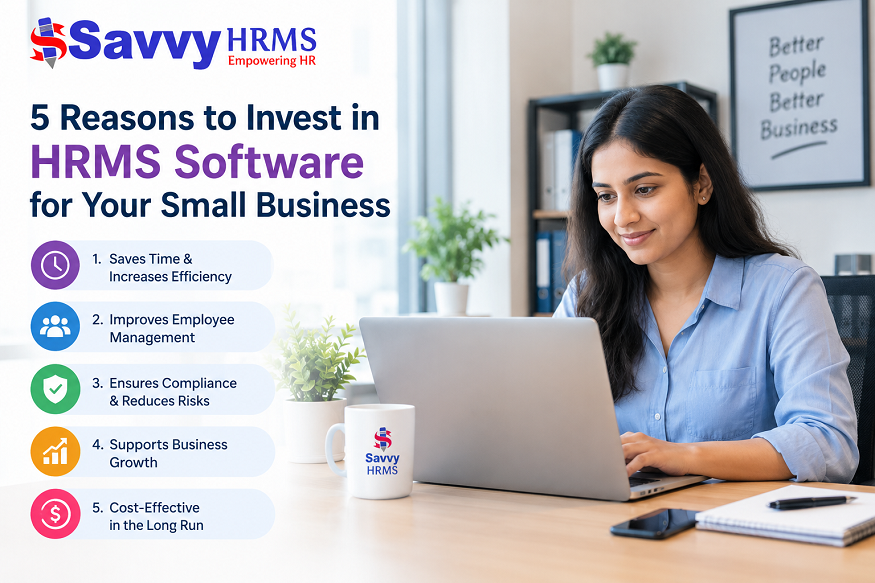
Running a small business involves more than finding customers and growing sales. You also need to manage employees, track attendance, process salaries, handle leave requests, and maintain employee records. When these tasks depend on spreadsheets and paperwork, they can take time away from your core business activities.
This is where HRMS software in India can help, as it brings key HR activities together in one system and helps businesses manage everyday tasks with less manual effort. In this blog, you will find five reasons why investing in HRMS software can benefit your small business.
1. Save Time on Daily HR Tasks
Small business owners and HR teams often handle several responsibilities at once. Managing employee records, checking attendance, approving leave, and preparing payroll can take time away from important business activities.
HRMS software helps organise these activities and reduce repetitive work. It can help small businesses:
- Automate routine HR tasks and reduce manual effort.
- Keep employee information organised in one place.
- Track leave requests and pending approvals.
- Reduce repeated data entry across different processes.
- Give HR teams more time for hiring and employee support.
By reducing administrative work, HRMS software helps small businesses manage daily HR responsibilities more efficiently.
Read More: AI Source Tracking Every Answer: Why Transparent AI Matters with Cognis
2. Improve Attendance and Leave Management
Businesses face challenges when they need to monitor their workers during various shifts and across multiple locations while following different attendance regulations. Paper-based attendance tracking systems, which use registers and spreadsheets produce missing data points, generate inaccurate work duration records and slow down the process of attendance report creation.
HRMS software provides businesses with a structured system that lets them track employee attendance while handling their leave application process. The available solutions provide biometric device support with shift scheduling and attendance regularisation functions which depend on the user’s chosen plan and their system integration capabilities.
The system allows managers to view attendance data while they monitor staff schedules and give their approval for vacation requests. The system provides employees with direct access to their attendance records and remaining leave days through its self-service portal.
3. Make Payroll Processing Easier
The HR department must handle payroll as employees need their salary payments to arrive correctly on their scheduled payment dates. The payroll process requires companies to handle multiple details, including employee salary plans, their work schedule and their time off, their deductions and their reimbursement payments and their required legal contributions.
The manual information collection process by HR teams creates opportunities for data entry mistakes to happen. The management needs to dedicate additional time to document verification before they can complete the salary payment process.
HRMS software with payroll features enables businesses to manage salary details through a single platform which eliminates the need for duplicate data entry operations. The system enables organizations to perform salary computations, generate payslips and handle deduction processes and all required legal procedures.
4. Keep Employee Information Organised
Employee information includes employment details like joining date and salary information, and documents. The process of finding current records becomes difficult as these records exist in multiple places including email accounts, spreadsheets, and physical document storage.
HRMS software provides a better place to maintain employee records where authorized personnel gain access to essential information through their authorized accounts. Organizations can handle employee data and personal data updates and complete employee record maintenance through their platform selection for business operations.
With the system, HR teams achieve process consistency through centralized records which they use to handle employee onboarding, position transitions and termination management.
5. Support Business Growth
HR processes that work for a small team may become harder to manage as employee numbers increase. More employees can mean additional attendance records, leave requests, payroll entries, and administrative tasks.
HRMS software helps businesses build consistent processes and prepare for changing workforce needs. It can help small businesses:
- Manage a growing workforce with less manual work.
- Add HR functions such as recruitment, onboarding, and performance tracking.
- Review workforce information through reports.
- Manage HR activities across multiple locations, where supported.
- Adapt to changing needs with suitable plans and features.
Before investing, review employee limits, pricing, upgrade options, and available support. Choosing software that fits your current needs and plans can help you avoid switching systems too soon.
How to Choose the Right HRMS Software in India
The right HRMS solution should match your business needs, budget, and existing processes. Before making a decision, compare a few providers and check whether their features solve your main HR challenges.
Consider these factors:
- Essential features: Look for the HR functions you need, such as attendance, leave, payroll, and employee records.
- Ease of use: Make sure employees and managers can complete common tasks without difficulty.
- Pricing: Check subscription fees, implementation costs, employee limits, and charges for additional modules.
- Integration: Confirm compatibility with your existing payroll systems, biometric devices, and other business tools.
- Support and security: Review customer support options, access controls, and data protection measures.
- Scalability: Choose a solution that can support your business as employee numbers and HR requirements increase.
You can also request a product demonstration to see how the software handles everyday tasks before making a commitment.
Conclusion:
Investing in HRMS software in India can help small businesses reduce manual work, manage attendance, simplify payroll, organise employee records, and prepare for growth. The right solution depends on your team’s needs, available budget, and plans for the future.
Read More: Why Cloud-First Payroll Platforms Are Dominating Industry Conversations
Start by identifying your biggest HR challenges, then compare software features and pricing before making a decision.
Ready to Make HR Management Easier?
Book a free demo and explore how Savvy HRMS solutions bring essential HR tasks together to help your small business manage its growing team with greater ease.